
In the rapidly evolving world of Automotive Mechatronics, one question dominates the forums of tuning enthusiasts and professional technicians alike: Is there a fundamental hardware gap in Truck vs Car ECU design? For years, the heavy-duty sector was treated as a “black box” of mystery, often intimidating passenger car mechanics with its 24V systems and massive industrial engines. However, as we move through 2026, the convergence of embedded systems has bridged this gap more than ever before.
The Engineering Paradox: Shared DNA in EDC15 Systems
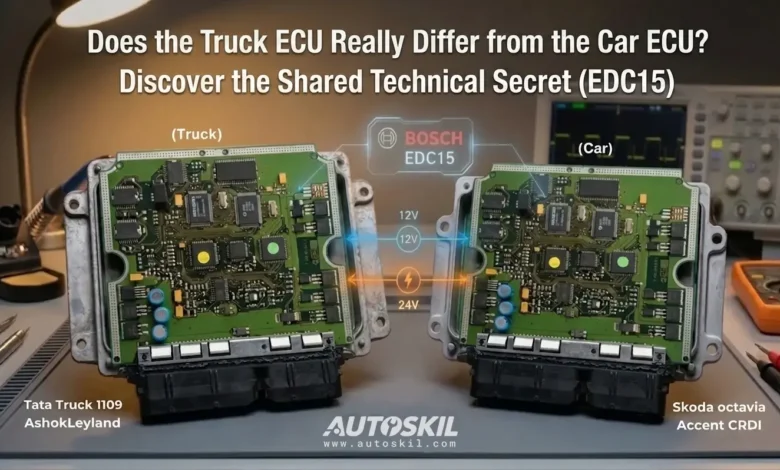
To understand the core of ECU repair and programming, we must look at industry giants like Bosch. The EDC15 (Electronic Diesel Control) generation is the perfect case study for the Truck vs Car ECU debate. If you disassemble an ECU from a compact Skoda Octavia and place it next to a heavy-duty unit from a Tata Truck 1109 or an Ashok Leyland commercial vehicle, the internal architecture will surprise you.
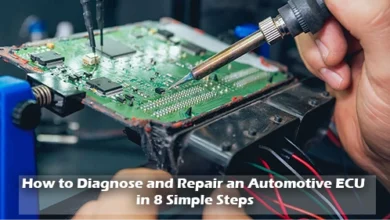
Despite the massive difference in engine displacement and vehicle utility, these units often share up to 70% of their hardware components. The microprocessors (often from the Siemens or Infineon families), the EEPROM chips, and the driver ICs that manage injector pulses are frequently identical. Manufacturers utilize this shared hardware to reduce production costs, proving that your skills in car ECU repair are directly transferable to the high-ticket truck market.
Voltage Challenges: Demystifying the 24V Power Circuit
One of the primary search intents for technicians today is understanding power management. While passenger cars in the USA operate on a standard 12V DC system, heavy-duty trucks utilize 24V to support the high cranking amps required for diesel engines. This often leads to the misconception that a 24V ECU will “fry” if tested with car diagnostic tools.
In reality, the internal logic of a Truck vs Car ECU often operates at the same 5V or 3.3V logic level. Modern voltage regulators within the unit are designed to step down the input voltage. Many heavy-duty units, specifically in the BS III and BS IV categories, are remarkably resilient and can even be powered on a bench using a standard 12V power supply for basic data reading and ECU programming. Understanding these protection circuits – specifically the role of varistors and transient voltage suppression (TVS) diodes -is what separates a hobbyist from a master technician.
| Technical Feature | Passenger Car (12V) | Heavy Truck (24V) |
|---|---|---|
| Main Processor | High Speed (Flash based) | High Speed (Robust Flash) |
| CAN-Bus Speed | 500 kbps (Standard) | 250/500 kbps (J1939) |
| Map Structures | Efficiency Optimized | Torque & Load Optimized |
Software: Where the Real Magic Happens
While the “body” (hardware) may be similar, the “soul” (software) is where the Truck vs Car ECU distinction becomes clear. In the USA truck market, Heavy-duty ECM diagnostics focus heavily on torque limiters and smoke maps. A truck engine must move 40 tons of cargo, requiring a completely different fuel injection timing strategy compared to a car designed for fuel economy.
When performing ECU programming, professional tuners use specialized software like WinOLS to identify these maps. For a car, you might look for turbo boost pressure to increase horsepower. For a truck, you are looking at the “EGR Delete” or “DPF/SCR” parameters to ensure the engine survives harsh industrial environments. This distinction in software “tuning” is the only real wall between the two sectors.
Opportunities for Professional Growth in 2026
The market for truck diagnostics is significantly more lucrative than the saturated passenger car market. By mastering the Truck vs Car ECU technicalities, you position your shop as a specialized hub. The average cost for a heavy-duty ECM repair in the US can be 3x higher than a standard car ECU repair, simply due to the specialized knowledge required to navigate the J1939 communication protocols and high-voltage protection circuits.
Key Takeaways for Your Workshop:
- Cross-Compatibility: Don’t be afraid to source components (like driver ICs) from car ECUs for truck repairs if the part numbers match.
- Bench Testing: Always use a current-limited power supply when testing unknown truck units to prevent damage.
- Documentation: Maintain a database of EDC15 pinouts for both 12V and 24V variants.
Closing Technical Note: Whether you are dealing with a Siemens, Bosch, or Delphi unit, the fundamentals of ECU repair and programming remain the same. Hardware is math; software is logic. Master both, and the type of vehicle ceases to matter.