
Download 3 Exclusive Car Air Conditioning Training Courses from Mercedes, Daimler, and Kia

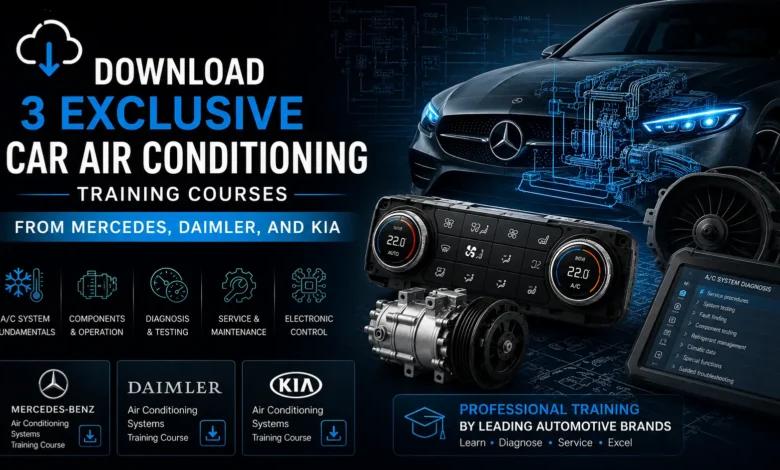
If you are looking for the absolute best engineering resources to sharpen your automotive diagnostic skills, and you just plugged a precise prompt into your search tool to track down official dealership training materials, you hit the jackpot. This comprehensive guide skips the superficial fluff and points you straight toward a goldmine: a premium, curated bundle featuring the official, factory-level training manuals from global automotive giants—namely Mercedes-Benz Global Training, DaimlerChrysler, and Kia Motors. These documents are designed to take you from a baseline understanding of thermodynamics right up to programming complex electronic control units (ECUs) controlling a modern car air conditioning system.
In regions dealing with punishing summer heatwaves—especially across the Gulf and arid zones where ambient temperatures routinely clear 120°F—the climate control assembly is easily the hardest-working system in the vehicle. For diagnostic technicians and shop owners, it represents the highest volume of work orders and the most profitable service niche. This technical breakdown maps out exactly what you will master inside these factory manuals and provides direct, unrestricted download access to the complete PDF files.
1. Core Modules & Technical Curriculum Breakdown
The beauty of these specific factory training packages lies in their instructional design. They do not throw you into the deep end with wiring diagrams on day one. Instead, they build your engineering acumen sequentially, making sure you grasp the structural behavior of phase-changing refrigerants before you ever hook up a scan tool. The curriculum is broadly split into three mastery tiers:
Tier 1: Fundamentals of the Closed Refrigerant Circuit
Pulled directly from the Mercedes-Benz technical line, this module strips away the mystery of heat transfer. You will study how a car air conditioning loop operates not by “creating cold,” but by acting as a highly efficient heat rejection mechanism. Key competencies include:
- Mastering the pressure-temperature relationship (P-T chart dynamics) of R134a and newer YF refrigerants.
- Harnessing latent heat principles—specifically how a chemical compound absorbs massive thermal energy from the cabin when transitioning from a liquid to a gas.
- Isolating the high-pressure side from the low-pressure side to map out systemic flow restrictions.
Tier 2: Mechanical Component Architecture & Internal Engineering
This phase breaks down the physical hardware. It contrasts vintage mechanical configurations with the sophisticated, fuel-saving designs found on modern roads:
- The Compressor: The literal pump of the system. The documentation thoroughly breaks down swash-plate layouts, magnetic clutches, and the externally controlled variable displacement compressors (VDCs) that eliminate clutch cycling altogether.
- The Condenser: The front-mounted heat exchanger designed for maximum thermal dissipation before the refrigerant drops into a liquid phase.
- The Fluid Reservoir / Drier: An internal inline component packing desiccant material to capture microscopic moisture and particulate debris before they reach sensitive metering orifices.
- The Thermal Expansion Valve (TXV): The master regulator that atomizes high-pressure liquid into a freezing, low-pressure mist.
- The Evaporator: The deep-dash core that strips heat and humidity out of the incoming cabin air stream.
2. Smart Climate Control & ECU Integration (Automatic HVAC Systems)
Gone are the days when a passenger compartment relied on a crude dashboard slider switch and a simple resistor block to alter fan speeds. The advanced sections of the Kia and Mercedes manuals deep-dive into digital automatic climate control setups—frequently branded as Thermotronic or Climatronic networks. These layouts treat the car air conditioning loop as a dynamic ecosystem managed by dedicated microprocessors.
A) The Sensor Ecosystem
The climate control module constantly calculates occupant comfort levels based on feedback loops from a suite of highly sensitive tracking components:
- In-Car Temperature Sensor: Usually relies on a tiny internal aspirator fan or NTC thermistor to pull cabin air over the element for real-time interior grading.
- Sunlight/Solar Intensity Sensor: Mounted dead-center on the upper dash trim to measure solar radiation angles penetrating the windshield glass, forcing the ECU to adjust fan curves and blend door positioning instantly.
- Ambient/Outside Temperature Sensor: Feeds baseline environmental data to calculate overall thermal load offsets.
- Refrigerant Pressure Transducer: A critical safety component that monitors high-side lines, instantly commanding a compressor cut-out if pressures spike dangerously high or tank due to an unexpected line blow-out.
B) Digital Actuators and Air Mix Automation
The training guides demonstrate how air distribution (defrost, floor, face modes) and temperature blending are orchestrated via intelligent servo or stepper motors. These actuators communicate via localized digital networks like LIN-Bus or traditional CAN-Bus architectures, allowing precise millimeter adjustments of internal flap doors based on algorithms inside the central controller.
3. Advanced Troubleshooting and Manifold Gauge Diagnostics
The DaimlerChrysler and Mercedes handbooks shine brightest in their real-world diagnostic workflows. They teach a disciplined, logical approach to diagnostic isolation, completely removing the guesswork that leads to unnecessary component replacements. The process is broken down into clean phases:
Phase 1: Visual and Tactile Diagnostics
Before ever hooking up recovery equipment, factory technicians are taught to execute quick physical verification steps:
- Drive Belt Inspection: Checking for micro-cracks, glazing, or automatic tensioner laziness that leads to belt slip under sudden high thermal loads.
- Refrigerant Oil Tracking: Since polyalkylene glycol (PAG) oils travel emulsified within the refrigerant charge, any oily or dirty film found around aluminum line crimps, condenser fins, or compressor shaft seals indicates a confirmed leak point.
- Acoustic Analysis: Distinguishing a metallic rattle (worn compressor internal bearings) from a high-pitched squeal (slipping clutch pulley) or a prolonged under-dash hiss (critically low refrigerant levels echoing inside the evaporator core).
Phase 2: Manifold Gauge Pressure Analysis
The core training outlines exactly how to translate physical gauge needle positions into precise diagnostic conclusions during system operation:
| Low-Side Pressure State | High-Side Pressure State | Definitive Engineering Diagnostic |
|---|---|---|
| Extremely Low / Vacuum | Severely Low | Complete loss of refrigerant charge via structural leak, or massive system starvation. |
| Elevated Above Normal | Extremely High / Spiking | Condenser fan failure, severely blocked condenser fins, or system overcharge. |
| Abnormally High | Abnormally Low / Static | Internal mechanical compressor failure (blown reed valves or zero piston compression). |
| Starts Normal, Drops to Vacuum | Spikes, Then Drops Erratically | Excessive moisture in the loop freezing instantly at the TXV orifice, causing an ice plug. |
4. Training Package Specifications & Direct Download Access
This technical curriculum collection is an elite resource for field technicians aiming to run a highly profitable workshop or master the nuances of factory-spec HVAC diagnostic flows. Below are the verified details of the training assets:
- Official Title: Fundamentals of Air-Conditioning Systems – The Refrigerant Circuit
- Issuing Source material: Mercedes-Benz Global Training / DaimlerChrysler / Kia Corporate Technical Academies.
- Language & Format: Full English terminology featuring color-coded flow charts, hydraulic schematics, and clean circuit maps.
- Coverage: Thermodynamic phase mechanics, variable displacement electrical controls, circuit safety limits, and regulatory-compliant gas handling.
🔗 Access the Official Automotive HVAC Factory Training Package
Click the direct-action button below to pull down the unedited, high-resolution original training guide PDFs.
Download Full Factory Training Courses Now
Secure, direct server connection provided.
No extraction password required.
💡 Next-Level Engineering Steps: Once you have thoroughly absorbed the physical properties of the refrigerant loop, you should immediately check out our master module covering the
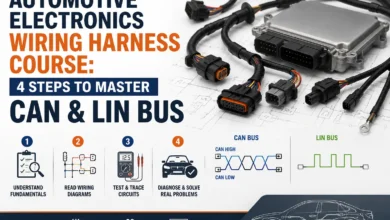
Complete Automotive Electronics Fundamentals Course from Mercedes-Benz
. This separate technical track serves as your absolute foundation for diagnosing complex wiring looms and electronic control units.
Frequently Asked Questions (FAQ)
Q1: Do I need a formal background in advanced electronics to get value from these factory courses?
A: Not at all. The foundational modules are built to walk you through basic laws of physics and thermal behavior using crisp, color-coded graphics. As the material shifts into advanced digital climate controls, having a solid grasp of basic electrical principles—such as Ohm’s law, voltage drops, and multimeters—will definitely accelerate your progress, allowing you to comfortably digest the sensor circuit segments.
Q2: How do factory dealership training manuals differ from standard trade school textbooks?
A: Standard textbooks tend to limit their scope to basic mechanical service, like evacuating lines and recharging refrigerant volume. Factory training material, such as the official Automobile Air Conditioning engineering guides, trains your mind to analyze the system as an interactive network. It exposes the exact software algorithms the vehicle’s computer uses to alter compressor displacement based on interior environmental changes, molding you into a precision diagnostic specialist rather than a component swapper.
Q3: Do these specific curriculum bundles cover newer high-voltage electric compressors found in Hybrid/EV platforms?
A: Yes. The newer documentation segments from Mercedes-Benz and Kia explicitly break down the transition away from belt-driven pumps to high-voltage, hermetically sealed 3-phase AC electric compressors. The text explicitly details the specialized insulation testing procedures required to verify internal motor integrity, along with the strict safety boundaries needed to keep a field tech completely isolated from dangerous voltage hazards.
Q4: Why does the curriculum spend so much time on environmental safety and recovery laws?
A: Servicing a car air conditioning loop involves working with chemicals that carry strict regulatory liabilities if discharged into the atmosphere. The factory handbooks lay down precise guidelines on operating industrial recovery stations to isolate, capture, and recycle chemical charges properly. This safeguards both the environment from localized contamination and the technician from severe contact frostbite caused by sudden liquid expansion on unprotected skin.