

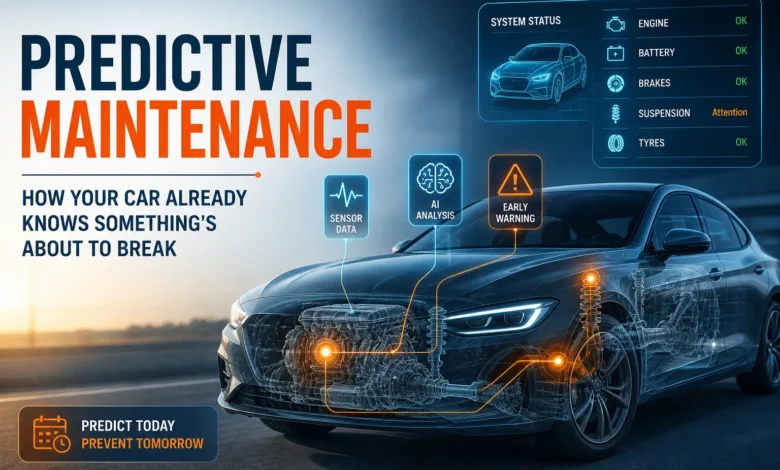
Predictive Maintenance: How Your Car Already Knows Something’s About to Break
Predictive maintenance sounds like something out of a fleet manager’s spreadsheet, but there’s a good chance it’s already quietly running in the background of your own car right now. If you’ve ever gotten a dashboard alert that felt oddly specific — not just “check engine,” but something closer to “battery may need service soon” — that’s predictive maintenance at work. Here’s what it actually is, how it’s different from the maintenance schedule you already know, and what it means for how you take care of your car going forward.
What Is Predictive Maintenance, Really?
Predictive maintenance is a way of catching a problem before it actually becomes a problem — using real data from your car’s own sensors instead of a generic mileage schedule taped inside your glove box. Instead of “change the brake pads every 30,000 miles regardless of how they’re actually wearing,” a predictive system watches how your specific pads are wearing on your specific car, under your specific driving habits, and flags them when the data says they’re actually close to done.
This isn’t some far-off concept, either. According to market research from Transparency Market Research, the market for predictive maintenance in vehicles is projected to roughly quadruple by the mid-2030s, and North America is leading that growth thanks to a strong connected-fleet ecosystem and heavy investment from companies like Bosch, Continental, and ZF. If you’ve bought a car in the last few years with any kind of connected services subscription, some version of this is probably already built in.
Predictive Maintenance vs. Preventive Maintenance: What’s the Difference?
These two terms get mixed up constantly, and honestly, it’s a fair mix-up — they’re both about avoiding breakdowns. The difference comes down to how the timing gets decided.
| Approach | How Timing Is Decided | Example |
|---|---|---|
| Reactive Maintenance | After something already fails | Your alternator dies and the car won’t start |
| Preventive Maintenance | Fixed schedule, regardless of actual wear | Oil change every 5,000 miles, no matter what |
| Predictive Maintenance | Real-time data and wear patterns specific to your car | An alert that your battery’s internal resistance is trending toward failure, weeks before it actually dies |
Preventive maintenance is still smart — you shouldn’t skip oil changes waiting for a sensor to tell you to. But predictive maintenance is what catches the stuff a fixed schedule was never built to catch, especially failures that happen well before or after the “normal” mileage window.
How Predictive Maintenance Actually Works Under the Hood
The whole system leans on three things working together:
- A network of sensors: the same kind of sensors and actuators already in your car are constantly logging small details — voltage patterns, temperature swings, vibration signatures — most of which never even trigger a warning light on their own.
- An internal data network: that sensor data has to actually get somewhere. It travels across the vehicle’s internal CAN bus system, the same communication backbone that’s been quietly running your car’s electronics for decades.
- Cloud-based analytics: for cars with a connected services plan, that data gets compared against huge benchmark datasets from thousands of similar vehicles, which is how the system knows what “normal” wear actually looks like versus what’s trending toward failure.
Predictive maintenance doesn’t stop at just flagging a problem, either. On cars with over-the-air update capability, some software-related issues can get patched remotely before you ever notice anything was wrong — no shop visit required. As Excelfore points out, this shift is closely tied to the broader move toward software-defined vehicles, where diagnostics and remote fixes increasingly work together instead of as separate steps.
💡 Pro Tip:
If your car has a connected services app, don’t just ignore the notifications tab. A lot of drivers only check it for software updates, but that’s often where predictive maintenance alerts show up first — sometimes weeks before a dashboard warning light would have caught the same issue.
Real Examples of Predictive Maintenance Working Right Now
This isn’t just a market research buzzword. A few places where predictive maintenance is already showing up in real vehicles:
- EV battery health tracking: instead of waiting for range to noticeably drop, connected EVs can track subtle cell-level degradation patterns and flag battery health trends long before it becomes a daily annoyance — a bigger deal every year as more EVs like the Hyundai Ioniq 5 hit the road.
- Brake pad wear estimation: some systems now estimate remaining pad life based on actual braking force and frequency, not just a mileage counter.
- Starter and alternator behavior drift: subtle voltage or cranking-time changes can get flagged well before you’re stuck with a dead battery in a parking lot.
- Fleet and commercial vehicles: this is where predictive maintenance has matured the fastest — companies like Geotab are running predictive maintenance across millions of connected vehicles to cut down on unplanned downtime.
📌 Good to Know:
Predictive maintenance features tend to roll out fastest on EVs and higher-trim connected vehicles first, simply because those cars already have the sensor density and data connection needed to make it work. Older or base-trim vehicles may still rely mostly on traditional preventive schedules.
Predictive Maintenance vs. the Check Engine Light You Already Know
Your check engine light and OBD2 scan tools are built around a different philosophy: something has already gone outside an acceptable range, and now you’re being told about it. That’s reactive by design — useful, but it’s telling you about a problem that already exists.
Predictive maintenance is trying to get ahead of that moment entirely. Think of it as the difference between a smoke detector (tells you there’s already a fire) and a system that notices your wiring is slowly overheating weeks before it would ever spark. Both matter — they’re just solving different problems.
⚠️ Heads Up:
Predictive maintenance is a helpful early-warning layer, not a replacement for actual inspections. Sensors can drift, throw false positives, or miss purely mechanical issues that don’t show up as a data pattern. If a predictive alert pops up, treat it as a reason to get the car looked at — not a diagnosis on its own. For anything the alert flags on the electronic side, a proper scan and a look at the ECU diagnostic process is still the right next step.
Is Predictive Maintenance Already in Your Car?
If your car was built in the last three or four years and came with any kind of connected services trial (think GM’s OnStar, Ford’s FordPass, or similar programs from other automakers), there’s a real chance some predictive maintenance features are already active — even if nobody at the dealership specifically pointed it out when you bought it. Check your connected services app’s settings or notification history; that’s usually where these alerts live, quietly, until you actually need them.
Predictive Maintenance FAQ
What is predictive maintenance in a car, in one sentence?
It’s using real sensor data from your specific car to predict when a part is likely to fail, instead of relying only on a fixed mileage schedule.
Is predictive maintenance the same as preventive maintenance?
No. Preventive maintenance follows a fixed schedule regardless of actual wear. Predictive maintenance adjusts based on real, ongoing data from your car.
Can predictive maintenance replace my regular oil change schedule?
Not entirely. Some systems do offer oil-life monitoring based on actual driving conditions, but it’s smart to treat that as a refinement of your maintenance schedule, not a total replacement for routine service.
Do all new cars have predictive maintenance?
No. It’s most common on EVs and higher-trim connected vehicles right now, since those cars already have the sensor coverage and data connectivity the feature needs to work well.
Does predictive maintenance cost extra?
Sometimes. Many automakers bundle it into a connected services subscription that’s free for a trial period, then becomes a paid add-on afterward — worth checking your specific automaker’s terms.
Predictive maintenance isn’t some futuristic concept anymore — it’s already sitting quietly in the background of a lot of cars on the road today, and it’s only going to get more common as connected vehicles become the norm rather than the exception. The smartest move as a driver is simple: don’t ignore those connected app notifications, keep up with your regular service schedule anyway, and treat predictive alerts as an early heads-up rather than the final word.