
Does Your Car Need ADAS Calibration After a Windshield Replacement?
ADAS calibration is the step a lot of drivers skip right past after a cracked windshield gets replaced — and it’s the one that actually matters most for safety. If your car has lane-keep assist, automatic emergency braking, or adaptive cruise control, there’s a very good chance a camera is mounted right behind that glass, and swapping the windshield can knock its aim off just enough to matter. Here’s when you actually need ADAS calibration, what it costs, and why “the car drives fine” isn’t proof that everything’s actually working.
Why Windshield Replacement and ADAS Calibration Are Even Connected
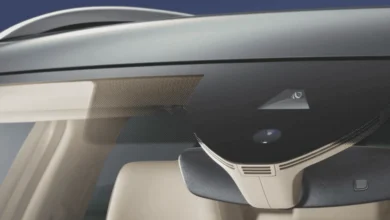
On most modern vehicles, the forward-facing camera that powers a chunk of your ADAS features isn’t bolted to the body of the car — it’s glued directly to the windshield itself, usually tucked up near the rearview mirror. That camera is aimed with extremely tight tolerances during manufacturing, sometimes within a fraction of a degree, because it’s feeding data to systems that are making split-second braking and steering decisions.
Pull that windshield out and put a new one in, and even a perfect installation can shift that camera’s exact aim just enough to throw off what it “sees.” The car will still drive completely normally. The dash might not even throw a warning light. But the sensor behind that glass could now be misreading distance, lane position, or a pedestrian’s location by just enough to matter in an emergency.
Which ADAS Features Actually Depend on the Windshield Camera?
Not every safety feature runs through that windshield-mounted camera, but a lot of the big ones do:
- Automatic emergency braking and forward collision warning
- Lane departure warning and lane-keep assist
- Adaptive cruise control (often paired with a radar unit too, usually in the front bumper)
- Pedestrian and cyclist detection
- Rain-sensing wipers and auto high-beams, which usually share the same camera housing
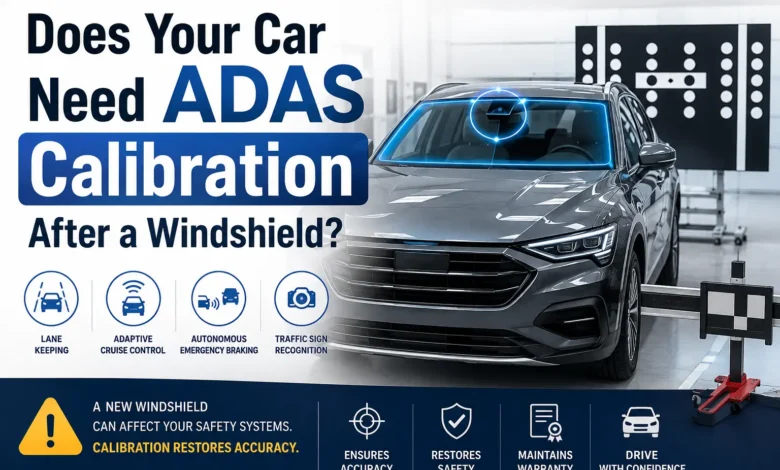
If your car has any of these and the windshield gets replaced, ADAS calibration isn’t optional maintenance — most automakers list it as a required step, not a suggestion.
Static vs. Dynamic ADAS Calibration: What’s the Difference?
Static calibration: done in the shop with the car parked, using printed targets, laser rigs, or radar reflectors set up at exact, manufacturer-specified distances and angles. This is the more controlled, more common method for camera-based systems.
Dynamic calibration: done by actually driving the car under specific conditions — a certain speed range, clear lane markings, good weather — while a scan tool monitors the system as it self-calibrates in real time.
Some vehicles only need one or the other. Plenty of newer models need both, done back to back, which is part of why the process can easily eat up an hour or more of shop time.
💡 Pro Tip:
Before you agree to a windshield replacement, ask the glass shop directly whether they perform ADAS calibration in-house or send the car out to a dealership or third party. This affects your total timeline and, in some cases, your total cost — and it’s a lot easier to ask upfront than to find out after the glass is already in.
How Much Does ADAS Calibration Actually Cost?
This is where a lot of drivers get caught off guard. According to Car Talk, ADAS calibration after a windshield replacement typically runs somewhere between $250 and $700, with the exact number depending heavily on your specific make and model. AAA’s research goes further, noting that on vehicles with a windshield-mounted camera, the glass replacement itself can run around $1,500 — close to triple what it’d cost on a car without that technology — and windshield damage alone accounts for a huge share of the more than 14.5 million windshield replacements that happen in the U.S. every year.
| Factor | How It Affects Cost |
|---|---|
| Make and model | Some manufacturers require dealer-only calibration equipment, which tends to cost more than third-party shops |
| Number of systems involved | A car with camera-only ADAS costs less to calibrate than one combining camera and radar |
| Static vs. dynamic requirement | Needing both methods adds shop time and, often, cost |
| OEM vs. aftermarket glass | Some automakers require factory glass with specific optical properties for the camera to calibrate correctly at all |
📌 Good to Know:
If you’re filing this through insurance, ADAS calibration is typically covered under comprehensive coverage alongside the windshield itself — you’ll usually just be responsible for your deductible. It’s worth confirming with your insurer before you assume you’re paying full price out of pocket.
What Happens If You Skip ADAS Calibration?
Plenty of drivers do skip it, and plenty of the time, nothing visibly goes wrong. That’s exactly what makes it risky. A slightly misaligned camera doesn’t usually announce itself — it just quietly makes automatic emergency braking trigger a beat late, or nudges lane-keep assist to correct in the wrong direction by a few inches. You won’t notice until the one time it actually matters.
⚠️ Heads Up:
A clean dashboard with no warning lights is not proof that ADAS calibration was done correctly, or done at all. These systems can fail “silently” — passing a basic self-check while still being aimed incorrectly. If you had a windshield replaced and you’re not sure calibration happened, it’s worth getting it verified with proper diagnostic equipment rather than assuming.
How to Make Sure ADAS Calibration Actually Happened
- Ask for documentation. A legitimate shop performing ADAS calibration should be able to hand you a printout or report confirming which systems were calibrated and that they passed.
- Test the features you rely on, carefully. In a safe, open area, confirm lane-keep assist and adaptive cruise are behaving the way they always have — not as a substitute for professional calibration, just a sanity check.
- Get a scan if anything feels off. A shop with a proper OBD2 scan tool can pull calibration status and any related fault codes directly from the relevant module.
ADAS Calibration FAQ
Do I really need ADAS calibration, or is it a money grab?
If your car has camera-based safety features and the windshield was replaced, most automakers list calibration as a required procedure, not an optional upsell. Skipping it doesn’t break anything immediately, but it can leave those systems working with bad aim.
How long does ADAS calibration take?
Usually an hour or more, depending on the vehicle and whether it needs static calibration, dynamic calibration, or both.
Can I drive before ADAS calibration is done?
Yes, the car remains fully drivable. Just be aware that the ADAS features relying on that camera may not be functioning at full accuracy until calibration is complete.
Does insurance cover ADAS calibration?
In most cases, yes, under comprehensive coverage alongside the windshield replacement itself — though it’s always worth confirming directly with your provider.
Does every windshield replacement require ADAS calibration?
No — only vehicles with a camera or sensor mounted on or near the windshield. Older vehicles or base trims without ADAS features typically don’t need it.
ADAS calibration isn’t the glass shop trying to pad your bill — it’s the step that makes sure the safety features you’re actually relying on are pointed where they’re supposed to be. If your windshield gets replaced and your car leans on a camera for lane-keep assist, automatic braking, or adaptive cruise, treat calibration as part of the job, not an optional add-on, and don’t be shy about asking for proof it was done right.