
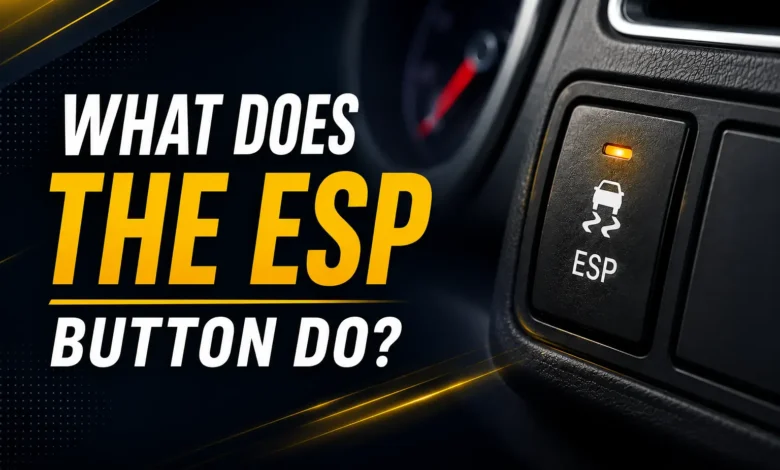
The ESP button is one of those controls almost every driver has bumped into by accident, then wondered what they just did. Some hit it on purpose when they’re stuck in mud, others panic when a little skidding-car icon lights up on the dash. Here’s the plain-English breakdown of what the ESP button actually does, how the system works under the hood, and when – if ever – you should actually turn it off.
So What Is ESP, Exactly? stands for Electronic Stability Program, and the ESP button is simply the switch that lets you turn that system on or off. Depending on the automaker, you’ll see the same technology sold under a different badge: Toyota and Ford usually call it ESC (Electronic Stability Control), some Toyota models use VSC, BMW calls it DSC, and Honda calls it VSA. Different name, same job.
ESP This has been mandatory equipment on new vehicles sold in the U.S. since the 2012 model year, and it’s widely considered one of the biggest safety wins in modern car design. It’s especially good at cutting down on rollovers and loss-of-control crashes – the kind that happen when a driver swerves hard to avoid something and the car doesn’t go where the wheel is pointed. According to Kelley Blue Book, the system works hand-in-hand with your car’s anti-lock brakes and traction control to keep you pointed the right direction during an emergency maneuver.
How the ESP Button and System Actually Work
The ESP button doesn’t do anything on its own – it flips a system that’s constantly crunching data from a handful of sensors, dozens of times per second:
- Steering angle sensor: tells the computer exactly where you’re trying to point the car.
- Yaw rate sensor: measures how much the car’s body is actually rotating around its vertical axis.
- Wheel speed sensors: the same ones your ABS uses, checking whether any single wheel is spinning faster or slower than it should be.
All of these sensors and actuators feed real-time data back to the control module over the vehicle’s internal network. If you want to go deeper on how that data actually travels between modules, our beginner’s guide to CAN bus systems breaks it down step by step.
When the computer notices a gap between where you’re steering and where the car is actually headed, it steps in within a fraction of a second, using two main tools:
Braking individual wheels: instead of hitting all four brakes at once, the system can pulse the brake on just one wheel to help rotate the car back onto your intended line.
Cutting engine power: it dials back throttle or ignition timing for a split second to reduce the chance of losing traction even more.
This covers the two classic ways a car loses grip: oversteer, where the back end swings out in a turn, and understeer, where the front end keeps plowing straight no matter how much you turn the wheel.
ESP Button vs. ABS vs. Traction Control: What’s the Difference?
These three systems share hardware, which is exactly why people mix them up. Here’s the cheat sheet:
| System | When It Kicks In | What It Actually Does |
|---|---|---|
| ABS | Only during hard braking | Stops the wheels from locking up so you can still steer while stopping short |
| Traction Control (TCS) | Only during acceleration | Keeps a wheel from spinning uselessly when you hit the gas on a slick surface |
| ESP | The whole time you’re driving — accelerating, braking, or turning | Manages overall side-to-side stability and stops the car from spinning out |
Think of it this way: ABS is a braking specialist, traction control is an acceleration specialist, and the ESP button controls the system that acts as the overall manager, borrowing tools from both.
When Should You Actually Press the ESP Button?
For normal day-to-day driving, leave it alone. But there are a few specific situations where hitting the ESP button to turn it off (or partially off) genuinely helps:
- You’re stuck in sand, mud, or deep snow: getting unstuck sometimes takes a little wheel spin to build momentum — something the system is specifically designed to prevent.
- You’re running tire chains: chains can confuse the wheel speed sensors, causing the system to step in when it doesn’t need to.
- You’re on a closed track: some experienced drivers switch ESP into a sport or partial-off mode for track days. This does not apply to public roads, ever.
💡 Pro Tip:
On most vehicles, a quick tap of the ESP button only disables traction control and leaves the rest of the system partially active. Holding the button down for several seconds is usually what fully disables ESP. Check your owner’s manual — this varies quite a bit between makes and models.
What Does the ESP Warning Light Actually Mean?
This is where a lot of drivers get thrown off, because the same little icon can mean two completely different things:
- The light flashes for a second or two, then goes out: totally normal — the system just stepped in to correct a minor slip, then backed off.
- The light stays on solid: that means you’ve manually switched the system off with the ESP button.
- The light comes on along with the check engine light or another warning: that usually points to an actual fault, often in the steering angle sensor or a wheel speed sensor, and it’s worth a scan tool diagnosis sooner rather than later.
According to a breakdown from Engineer Fix, the system relies on constantly comparing steering angle against actual yaw rate, which is exactly why it reacts faster than most human drivers ever could.
⚠️ Heads Up:
Never ignore a solid ESP light that’s paired with an actual fault code. Driving around with a broken stability system — as opposed to one you turned off on purpose — means you’ve lost one of your car’s most important active safety features without fully realizing it during everyday driving.
Why You Shouldn’t Turn Off ESP for Regular Driving
Some drivers assume switching off ESP gives them more “control” over the car. That’s true if you’re a skilled driver who knows exactly how to catch a slide — for everyone else, the system reacts faster than human reflexes can, especially in a sudden emergency like swerving to avoid a deer or a stalled car on the highway.
📌 Good to Know:
On most modern cars, the ESP button resets to “on” every time you restart the engine, even if you switched it off during your last drive. Don’t assume it stays off — glance at the dash every time you start a new trip.
Frequently Asked Questions
What exactly does the ESP button do?
The ESP button manually switches your car’s electronic stability program on or off. Left on (the default setting), it constantly watches how the car is moving and steps in automatically to prevent a skid. Pressing it disables that intervention — something you’d only want in specific situations, not daily driving.
Does turning ESP off affect gas mileage?
Not in any way you’d notice during normal driving. Any real difference only shows up during hard acceleration or repeated wheel spin, which isn’t something most drivers deal with regularly.
Can I fix an ESP fault myself?
Sometimes. A dirty wheel sensor or a blown fuse can trigger a false warning and is a fairly simple fix. Other times, you’re looking at a failed sensor or module, and that calls for pulling the actual trouble codes with an OBD2 scan tool before you replace anything — our guide on diagnosing and repairing an automotive ECU walks through that process in more detail.
Does every car have a physical ESP button?
No. Some newer models, particularly certain Toyota and Volkswagen vehicles, bury the stability control toggle inside the infotainment settings menu instead of giving you a dedicated physical button.
Is ESP the same thing as ABS?
No — this is a common mix-up. ABS only prevents wheel lockup during hard braking. ESP is the bigger-picture system that manages overall stability throughout your drive and uses ABS hardware as just one of its tools. The ESP button controls that larger system, not ABS itself.
The ESP button isn’t just a random switch on your dash — it’s your direct line to one of the most important active safety systems in your car. The simple rule: leave it alone for everyday driving, and only reach for it in clear-cut situations like being stuck in sand or mud, making sure to turn the system back on the moment you’re clear.