
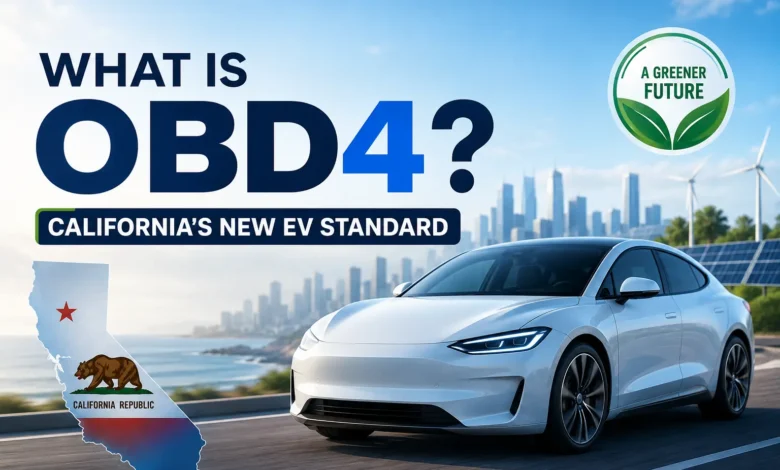
What Is OBD4? California’s New EV Diagnostic Standard, Explained
OBD4 is the nickname the industry has started using for a brand-new onboard diagnostic requirement rolling out on 2026 model-year EVs, and if you haven’t heard of it yet, you will soon. It’s not a marketing gimmick — it’s a real regulatory shift coming out of California, and it’s about to change how shops, dealerships, and even DIY owners plug into an electric vehicle. Here’s what OBD4 actually is, why California is behind it, and what it means whether you’re wrenching on cars for a living or just trying to keep your own EV running right.
What Is OBD4, Exactly?
Let’s clear something up right away: you won’t find the term “OBD4” in any official SAE or CARB paperwork. The actual document is called SAE J1979-3, and it’s the technical standard behind California’s new EV diagnostic mandate. “OBD4” is just the shorthand the aftermarket and repair world has started using because, frankly, it’s a lot easier to say than “J1979-3” at the counter.
In plain terms, OBD4 is a standardized way for scan tools to talk to an EV’s brain — no more guessing games with proprietary connectors or manufacturer-only software. Right now, if you own an EV, there’s a decent chance your car’s diagnostic data is locked up tighter than a drum, and independent shops are stuck either buying expensive OEM tools or just turning the job away. OBD4 is California’s fix for that.
Why Is OBD4 Happening Now?
This one traces straight back to Sacramento. California’s Advanced Clean Cars II program requires every 2026 model-year vehicle sold in the state to include this standardized diagnostic system, and seven other states that follow California’s emissions playbook are lining up behind it too. That’s a big chunk of the U.S. new-car market that’s about to be affected, whether or not your particular state has adopted the rule yet.
The reason it matters so much for EVs specifically? Gas cars have had a uniform diagnostic standard since OBD2 became mandatory back in 1996. EVs never really got that. Every automaker built its own walled garden, which meant a Chevy Bolt, a Rivian, and a Tesla could all fail in completely different ways with completely different tools needed to figure out why. OBD4 is meant to put every EV on the same page, the same way OBD2 did for the gas-engine world thirty years ago. According to reporting from Automotive Addicts, the goal is a diagnostic framework comprehensive enough to monitor an EV’s health across every major high-voltage system, not just throw a generic warning light.
📌 Good to Know:
OBD4 isn’t replacing OBD2 for gas and hybrid vehicles. It’s an EV-specific layer that sits alongside the existing standard, built to handle the parts of a car that gas-only OBD2 was never designed to look at — high-voltage batteries, power electronics, and EV-specific charging hardware.
OBD4 vs. OBD2: What’s Actually Different?
| Category | OBD2 | OBD4 (SAE J1979-3) |
|---|---|---|
| Introduced | Mandatory in the U.S. since 1996 | Rolling out on 2026 model-year EVs |
| Built for | Gas and hybrid engines, mainly emissions | Electric vehicle powertrains and high-voltage systems |
| Who mandates it | EPA / CARB, nationwide | CARB via Advanced Clean Cars II, California-led |
| Connector | Standardized 16-pin port | Still finalizing hardware specs, but built around the same standardized-access philosophy |
What Systems Does OBD4 Actually Cover?
The J1979-3 standard behind OBD4 isn’t just about throwing a check-engine-style light on the dash. It’s built to give real diagnostic access to the parts of an EV that have historically been a black box:
- Propulsion system: the electric motor and drive unit that actually move the car.
- Battery pack: state of health, cell balancing, and thermal behavior of the high-voltage battery.
- Power electronics: inverters and converters that manage how power flows through the vehicle.
- Charging system: both onboard AC charging and DC fast-charging hardware.
- Thermal management: the cooling and heating loops that keep the battery and motor happy.
This is a much bigger diagnostic footprint than what OBD2 was ever asked to handle, which makes sense — a gas engine and an EV powertrain barely share any DNA.
Do You Need a New Scanner for OBD4?
Short answer: probably, eventually, but not overnight. Since OBD4 is brand new for the 2026 model year, most of the scan tools sitting on shop shelves right now weren’t built with J1979-3 support baked in. If you’re running an OBD2 scan tool from a few years back, it’s going to read your gas-powered customers just fine, but it likely won’t have full access to a 2026 EV’s new diagnostic layer without a firmware update or a hardware refresh from the manufacturer.
💡 Pro Tip:
If you run an independent shop and you’re already seeing more EVs roll through the bay, don’t panic-buy a new scanner the second you hear “OBD4.” Call your current tool manufacturer first and ask about their J1979-3 roadmap — a lot of the bigger players are planning software updates rather than forcing a full hardware replacement.
What OBD4 Means for EV Owners and Shop Owners
If you’re an everyday EV owner, OBD4 is honestly good news. It’s the same logic behind the national Right to Repair conversation happening right now: standardized diagnostics mean you’re not locked into the dealership every time something goes sideways. More independent shops will be able to actually diagnose your battery pack or charging system instead of shrugging and sending you back to the dealer. If you’re shopping for an EV in the next year or two — say a new Hyundai Ioniq 5 or something similar — this is one more thing quietly working in your favor down the road.
If you’re on the shop side, this is a heads-up to start budgeting now. Between OBD4 compliance and the general shift toward EV work, the tool investment curve is only going one direction. It’s worth reading through our breakdown on diagnosing and repairing an automotive ECU if you want a refresher on the fundamentals before EV-specific tools land on your bench.
⚠️ Heads Up:
OBD4 is still a moving target. Final hardware specs, connector details, and the exact enforcement timeline can shift as automakers and CARB work through implementation. Treat anything you read right now — including this article — as the best current picture, not a locked-in final spec.
OBD4 FAQ
Is OBD4 an official SAE name?
Not officially. The real standard is SAE J1979-3. “OBD4” is industry slang that stuck because it’s easier to say and fits the same naming pattern as OBD1 and OBD2.
Does OBD4 apply to gas-powered cars?
No. OBD4 is specifically for electric vehicles. Gas and hybrid vehicles keep using the existing OBD2 standard.
When does OBD4 become mandatory?
California’s Advanced Clean Cars II program ties the requirement to the 2026 model year, with several other states that follow California’s emissions rules expected to adopt it as well.
Will my OBD2 scanner still work on a 2026 EV?
It’ll likely still pull basic data, but you probably won’t get full access to the new EV-specific diagnostics without a scanner that’s been updated to support J1979-3.
Why did California take the lead on OBD4 instead of the federal government?
California has set the pace on vehicle emissions and diagnostics standards for decades through CARB, and other states typically follow its lead. OBD4 is following that same well-worn path.
OBD4 is still brand new, still evolving, and still mostly flying under the radar outside of industry circles — which makes right now the best time to actually understand it before it lands in your driveway or your shop bay. Whether you’re an EV owner tired of dealership-only repairs or a technician gearing up for the next wave of tools, keeping an eye on OBD4 and SAE J1979-3 is time well spent in 2026.